Article: Full Eternity vs. Half Eternity Men’s Wedding Bands: Which Is Right for You?
Full Eternity vs. Half Eternity Men’s Wedding Bands: Which Is Right for You?
A full eternity men’s wedding band has stones around its entire circumference. A half eternity band concentrates stones across part of the ring, leaving a plain-metal section. Neither is universally better: the choice is about the pattern you want to see, the surfaces you want to feel and the service questions you want answered before ordering.
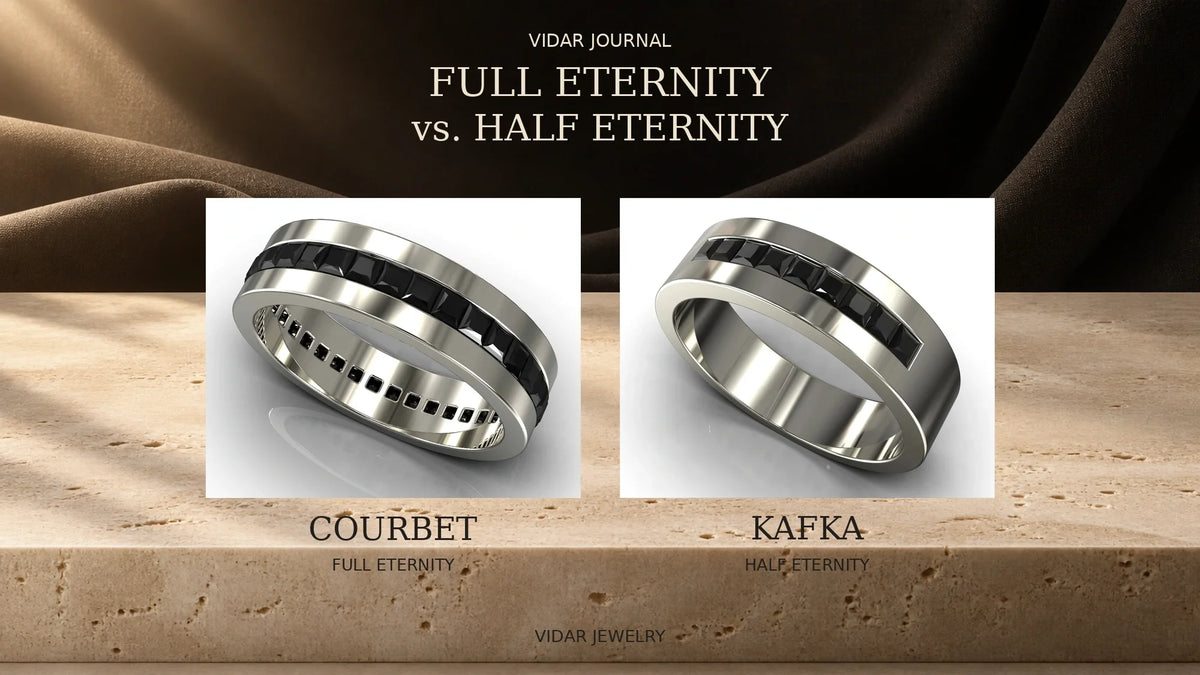
Two real Vidar designs make that distinction tangible: Courbet Ring — Full Eternity and Kafka Ring — Half Eternity. The versions shown both use princess-cut black diamonds in repeated layouts. They are different designs, not the same ring with coverage switched on or off; their proportions, stone arrangements and available configurations should be considered individually.
Start with coverage. Then compare fit, width, construction and your preferred stone selection.
Full Eternity vs. Half Eternity at a Glance
- Stone coverage: full eternity continues around the ring; half or partial eternity leaves a stone-free section.
- Visual continuity: full coverage carries the pattern around the circumference; partial coverage creates a transition between stones and plain metal.
- Feel: compare the actual outer surface, edges and inner profile. Coverage alone cannot predict comfort.
- Future sizing: a plain-metal section may offer different service possibilities, but either construction needs individual assessment.
- Cost: compare the complete configuration, including stone selection, metal, dimensions and setting work.
To place those choices alongside other designs, explore Vidar’s men’s wedding bands. Use coverage as one selection criterion rather than a shortcut for quality.

What Is a Full Eternity Men’s Wedding Band?
Stone Coverage Around the Entire Ring
Full eternity describes where the stones go: the repeated arrangement continues around the entire circumference. There is no deliberately stone-free segment on the outside of the band. Metal still forms part of the setting and ring structure; “full” does not mean that every surface is gemstone.
This distinction matters when looking beyond a front-facing product photograph. A top view can show an impressive row of stones without proving that the row continues underneath. Look for additional views and an explicit description of the coverage.
Meet Courbet: Vidar’s Full-Eternity Example
Courbet places princess-cut black diamonds around the circumference, framed by the surrounding metal. Its repeated dark pattern continues beyond the visible face. In the original angled image below, the stone-related openings visible along the inner rear section help show the construction beyond the front row.

What Is a Half Eternity Men’s Wedding Band?
Stone Coverage Across Part of the Ring
A half eternity design places stones across part of the circumference and leaves a plain-metal section. “Partial eternity” is a useful broader description of this approach. Do not assume that every ring sold under either term has an identical fraction of coverage; inspect the specific design and ask where its stone section ends.
The plain section is an intentional part of the appearance. As the ring turns, the balance between dark stones and exposed metal changes. Some buyers enjoy that contrast; others prefer a continuous pattern.
Meet Kafka: Vidar’s Half-Eternity Example
Kafka is Vidar’s half-eternity example, with princess-cut black diamonds in a channel across part of the band. The channel has a visible endpoint, followed by plain metal. Its partial coverage is confirmed by Vidar’s owner and designer.
Notice both the dark row and the metal beyond it. That transition is the detail to examine when deciding whether you want your wedding band to alternate between a gemstone face and a quieter metal surface.

How Full and Half Eternity Look Different on the Hand
Continuous Stone Pattern
With full coverage, the stone pattern continues as the ring rotates. Your view still changes with light, angle and the setting’s metal borders, but rotation does not reveal a deliberately plain segment of the outer band.
If continuity matters to you, look at the ring from the side as well as above. Ask whether you want a repeated dark line visible around the circumference or mainly across the face you see when your hand is relaxed.
Visible Plain Metal
Partial coverage gives the metal a distinct role alongside the stones. The transition can be subtle or prominent depending on the arrangement and how the ring sits. It is worth checking where the channel ends relative to the sides of your finger, without assuming a photograph predicts the position on your hand.
What You See From the Top vs. the Side
From above, both approaches may present a row of stones. Side and underside views reveal more about coverage. Before deciding, request views of the entire ring, including the plain section if one is present.
Coverage is also different from width. A broader band and a narrower band can each use full or partial coverage, with different proportions. Our 6mm vs. 8mm wedding-band guide considers that separate choice.

Comfort and Everyday Wear
What Can Sit Between the Fingers
Comfort depends on the complete ring: width, thickness, edge shape, inner profile, fit and the surfaces that meet neighboring fingers. Stones around the circumference may bring more of the setting into those contact areas. Partial coverage may place plain metal there, depending on its extent and the ring’s orientation.
Neither description establishes which ring will feel better to you. Ask to understand the profile and setting edges, and consider how the ring feels with your fingers together as well as spread apart. A familiar ring size is only one part of that assessment.
Think About Your Daily Activities
Think through typing, gripping handles, wearing gloves and other regular activities. The useful question is not simply whether a ring is “for everyday wear,” but how its dimensions and surfaces suit your routine. Avoid treating either coverage style as permission to expose a gemstone ring to heavy impact or pressure.
Discuss activity-specific care with the jeweler before ordering. For measuring and fit questions, use our ring size, fit and comfort guide rather than choosing a size from the coverage label.
Future Sizing: Why Stone Coverage Matters
Stone coverage changes the questions a jeweler must consider when assessing a size adjustment. A plain-metal section may provide a different area for possible work. It does not guarantee that a half-eternity ring can be resized, or establish how far it could change.
A full-eternity ring requires assessment of the setting around the band. Do not assume that it can never be altered, or that an alteration will be straightforward. The requested adjustment, metal, dimensions and construction all matter.
GIA’s ring-sizing guidance notes that channel settings and rings with diamonds around the entire band can be difficult to resize. That is a reason to ask about the exact design before purchase, not a substitute for an individual service assessment.
Ask: “If my size changes later, what options could be considered for this configuration?” Keep the answer specific to the ring you plan to order.
Maintenance and Inspection
Full coverage means the setting continues into areas you may not routinely examine from above. Partial coverage adds a transition between the stone section and plain metal. In either case, inspection should consider the complete ring, not just the stones most visible while wearing it.
Ask how to clean the exact configuration and which methods to avoid. Request guidance on checking setting edges and what to do if a stone seems loose, a surface feels different or the ring receives a significant knock. Arrange professional assessment when a concern arises rather than guessing from appearance alone.
There is no universal inspection timetable implied by “full” or “half.” Follow advice for the actual materials and construction. A plain-metal section still needs care, while a continuous stone pattern should not be mistaken for a maintenance-free surface.
Price: What Actually Changes the Cost?
Full eternity is not automatically more expensive than every half-eternity ring. A meaningful comparison holds as many choices as possible in view: stone count and total weight, stone selection, metal, width, construction and setting work.
A partial layout with different stones or proportions may not be comparable to a full layout at another specification. Compare the complete selected configuration, not an entry price beside a different option. Ask which choices explain the difference before treating coverage as the cause.
Both featured product records currently list natural and lab-grown diamond selections, alongside 14K, 18K and platinum metal options. Check the available combination for the design you prefer. These option labels do not, by themselves, establish color origin, treatment or certification.
Courbet vs. Kafka: Two Different Vidar Approaches
Courbet — Full Eternity: consider this design if a continuous princess-cut black-diamond pattern around the circumference is central to your preference. Look at the side and inner views as well as the front to understand its repeated arrangement.
Kafka — Half Eternity: consider this design if you want a defined black-diamond channel with a plain-metal section beyond it. Look closely at the endpoint of the stone row and the balance between stones and metal.
These are two different Vidar designs. The comparison does not establish equal width, stone count, total weight, price or comfort. Product photographs also do not provide a shared measurement scale. Open each design for its current options and additional views.
Explore Courbet | Explore Kafka
Which Coverage Style Should You Consider?
Choose by working through a few concrete preferences:
- Do you want the stone pattern around the entire ring? Full coverage addresses that visual priority.
- Do you prefer a plain-metal section? Partial coverage creates that contrast.
- How important is future sizing? Ask about the exact ring before relying on either label.
- How much stone presence do you want? Consider coverage together with the size of the stones and the surrounding metal.
- What surfaces feel comfortable to you? Consider the sides, underside and inner profile, not only the top view.
If you remain undecided, identify the feature you would miss most: uninterrupted stones or a deliberate plain section. Then check whether the actual design satisfies your practical requirements.
Customizing an Eternity-Style Men’s Wedding Band
A custom conversation can begin with coverage rather than a finished specification. Explain whether you prefer a continuous pattern or a partial arrangement, then discuss width, stone selection, metal and the relationship between the setting and plain surfaces.
Changing coverage can affect more than the number of stones. It may require a different layout or construction, so every proposed modification needs a feasibility assessment. Do not assume that an existing design can simply have stones added or removed without other consequences.
For the setting itself, our channel, bezel and flush setting comparison explains a separate design decision. When you can describe what you want to keep and change, start a custom-ring conversation with Vidar.
Questions About Full and Half Eternity Men’s Bands
Is Half Eternity the Same as Partial Eternity?
Both describe stone coverage that stops short of the entire circumference. “Partial” is broader; do not assume the terms specify the same exact fraction in every design. Check the ring’s views and confirmed construction.
Can Men Wear Eternity Wedding Bands?
Yes. Full and partial eternity are coverage choices for men’s wedding bands as well as other rings. Choose the proportions, fit and appearance that suit you; the coverage label does not prescribe who should wear it.
Can a Full Eternity Wedding Band Be Resized?
It requires individual assessment. Stones around the circumference can complicate the work, but a blanket “never” is not appropriate. Ask about the exact construction and the size change being considered.
Is a Half Eternity Band Easier to Resize?
A plain-metal section may create different service possibilities. It is not a guarantee of resizing or an approved adjustment range. Have the specific ring assessed before relying on that possibility.
Does Full Eternity Feel Different Between the Fingers?
It can, because the setting continues around the band. The actual experience depends on its edges, dimensions, profile and your fit. Partial coverage is not automatically more comfortable.
Can I Choose Natural or Lab-Grown Diamonds?
Both featured designs currently list natural and lab-grown diamond options. Confirm the available configuration on the exact product page or with Vidar before ordering; options should not be assumed across every design.
Can Vidar Customize the Amount of Stone Coverage?
You can request a coverage-focused custom design. Vidar must assess the proposed layout and construction before confirming feasibility. Bring your preferences about the plain section, continuous pattern and proportions to that conversation.