Men’s Wedding Band Settings: Channel vs. Bezel vs. Flush
VIDAR JOURNAL · DESIGN NOTES
Channel settings hold a row of stones between metal borders. A bezel frames a gemstone with a metal rim. A flush setting seats the stone into the band itself. For a men’s wedding band, the choice changes where your eye goes: along a line of color, toward a framed centerpiece, or into the surface of the ring.
No setting is the right answer for everyone. Start with the appearance you enjoy, then compare the actual ring’s profile, proportions and care requirements. Here, three current Vidar Jewelry designs make those differences easier to see.


Channel, Bezel and Flush Settings at a Glance
The setting is the way metal holds the stone; it is not the same thing as a gemstone’s shape or the overall style of the ring. A square ruby can be part of very different designs. A row of round diamonds can create a strongly geometric band when straight metal borders frame it.
- Channel: follow the line.
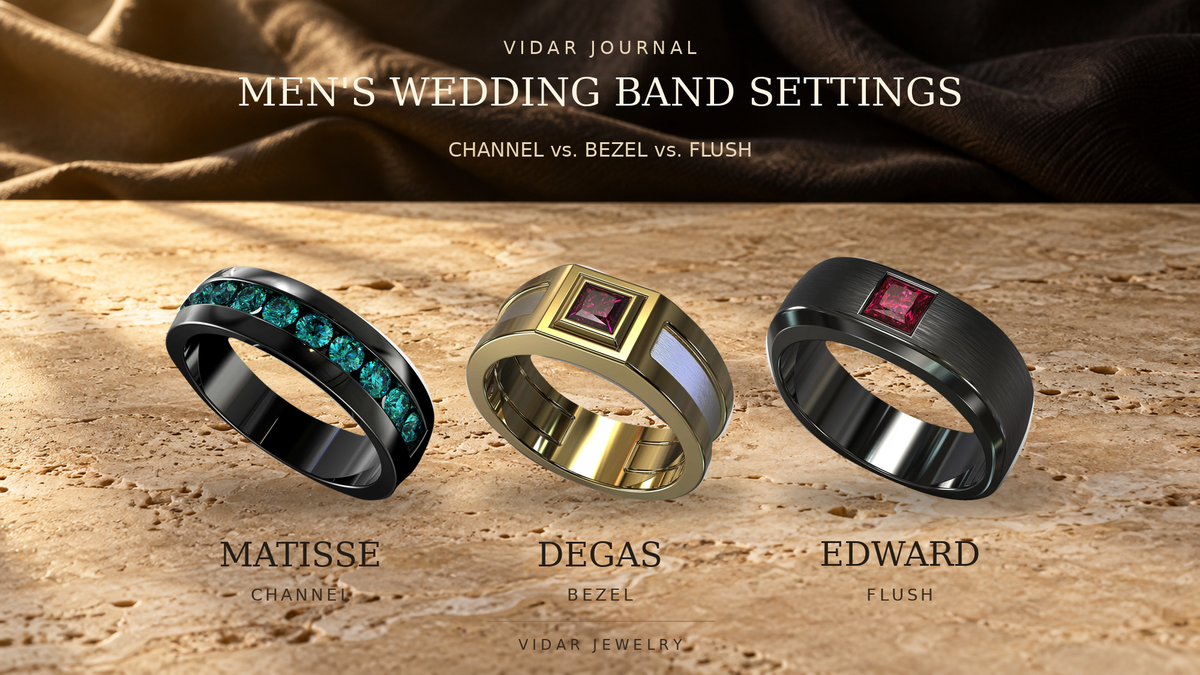
- Matisse Ring uses round blue diamonds through the center of a dark-finish band. The repeated stones create rhythm, while the surrounding metal gives the line a clear boundary.
- Bezel: notice the frame.
- Degas Ring brings attention to a central ruby and its gold bezel. The metal around the stone is an important part of the composition.
- Flush: read the surface.
- Edward Ring places a ruby within the face of a rounded-square band. The contrast between gemstone and metal creates the focal point.
Keep those three visual ideas in mind as you explore men’s wedding band designs. A setting name helps narrow the search, but the whole ring determines whether the design feels right for you.
Channel-Set Wedding Bands: A Continuous Stone Line
What the Channel Changes Visually
On Matisse, the channel draws your eye across repeated blue diamonds instead of toward one larger centerpiece. Round stones soften the pattern, while the metal borders keep the composition defined. That balance can appeal if you want visible gemstones within a band-led design.
A channel is not limited to a particular stone shape. What identifies it is the way the stones sit between the metal borders. Shape changes the rhythm inside that structure: rounded outlines and rectangular outlines do not produce the same pattern, even when both use a channel.
What to Check on a Channel-Set Band
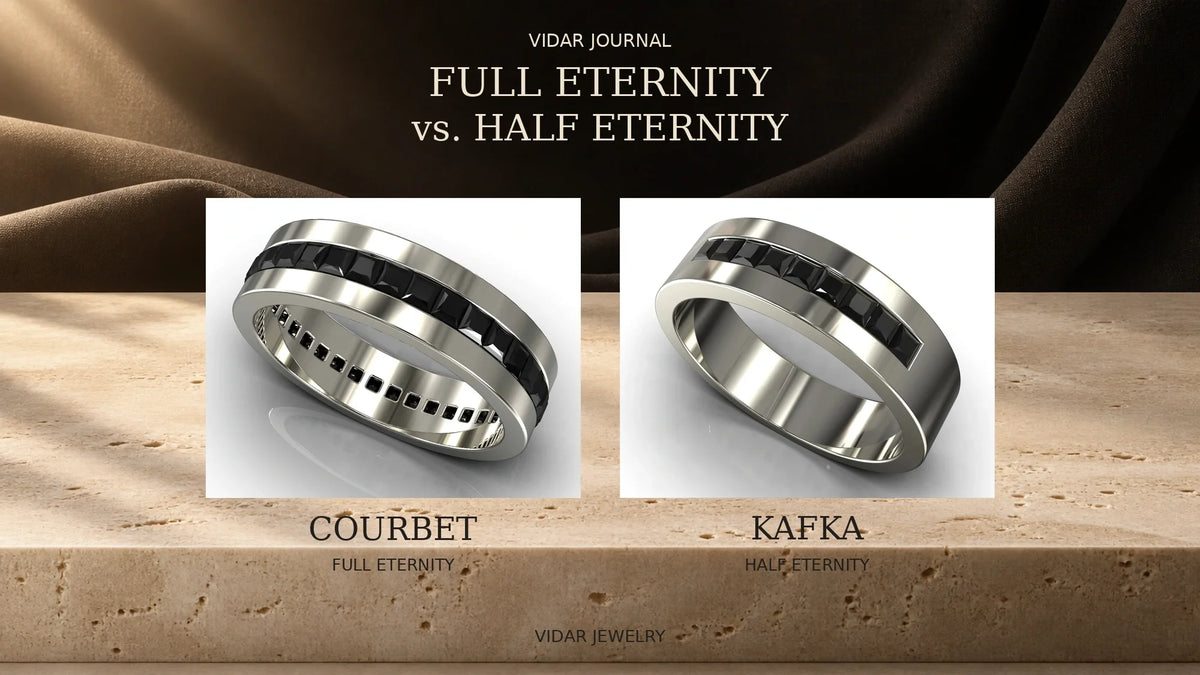
Look beyond the straight-on view. Where does the gemstone line begin and end? How much metal remains beside it? Does the design continue around the ring, or concentrate its detail across the visible face? Those questions help separate a setting method from stone coverage. If coverage itself is the decision you are making, compare full versus half eternity coverage using Courbet and Kafka as real Vidar examples.
Ask for views of the sides and underside before deciding. If future sizing matters, discuss the exact design rather than assuming that all channel-set rings can be altered in the same way. Stone placement and the structure of the band affect what a jeweler can assess or propose.
Bezel-Set Wedding Bands: A Defined Centerpiece
How the Metal Rim Frames the Stone
Degas takes a different approach: the ruby has a distinct gold frame, with the surrounding band continuing the design through grooves and contrasting surfaces. You notice both the gemstone and the metal defining its edge. The setting contributes to the ring’s character rather than disappearing from view.
A bezel can make the outline of a stone especially easy to read. For a buyer, the useful question is whether that framed effect appeals more than a repeated stone line. Neither approach is inherently more masculine or more appropriate for a wedding band; they simply direct attention differently.
Why the Side View Still Matters
The word “bezel” does not tell you the finished height of a ring. Compare the actual side profile and how the centerpiece meets the shoulders of the band. A photograph from above can make two constructions look more similar than they are.
Also consider the amount of visible metal around the gemstone. A defined frame is part of the look you are choosing. It should feel intentional to you, rather than being judged only by how much gemstone surface appears in a photograph.
Flush-Set Wedding Bands: Stones Within the Band
The Difference Between Flush and Bezel Settings
Edward shows how a ruby can become part of the band’s face. Its brushed surface and polished edges provide contrast around the gemstone without a separate raised centerpiece being the main visual feature. This design uses a flush setting.
Both flush and bezel designs involve metal around a stone, which is why they can be confused in a small photograph. Look at the relationship between the stone and the surrounding band, not simply whether a metal edge is visible. A bezel forms a defined frame; a flush setting seats the stone within the band.
What to Check Before Choosing Flush Settings
Consider the band as carefully as the gemstone. Its face, edge treatment and overall shape remain prominent, so a brushed or polished surface can influence your preference. Ask about the actual profile rather than treating “flush” as a promise that the entire ring has no projection.
A flush setting is also different from a comfort-fit interior. One describes how the gemstone is seated; the other concerns the surface against your finger. You need to evaluate both when choosing a ring to wear regularly.
Choosing a Setting for Your Daily Routine
Compare Profile, Exposed Edges and Your Activities
Describe your routine to the jeweler in practical terms. Do you frequently handle tools, lift weights, wear close-fitting gloves or work around rough surfaces? Those details are more useful than asking whether a ring is simply “durable.” A setting cannot make a precious-metal gemstone ring suitable for every task.
Ask where the stone’s edges are exposed, how the setting projects and what contact the ring is likely to experience. Gemstone condition, construction and wear habits all matter. Do not choose from a ranking that declares one setting universally safest, strongest or impossible to catch.
For activities that could damage the ring or create a safety risk, removing it may be the appropriate choice. Your work requirements and the care advice for your specific ring should guide that decision.
Ask About Cleaning, Inspection and Future Sizing
Care instructions should account for the actual gemstone, metal and finish. Do not assume that a cleaning method suited to one ring is right for another. Ask how to clean around the stones and when a professional inspection is appropriate, especially if the ring has received an impact or a stone feels loose.
For Vidar’s dark-finish designs, the black appearance is black rhodium plating over the precious-metal base. It is not a naturally black gold alloy. Finish wear and potential refinishing are separate considerations from the setting itself; discuss care for the finish as well as the stones.
Setting, Stone Shape and Band Width Are Different Choices
Round or Rectangular Stones Do Not Define the Setting
Stone shape describes the gemstone’s outline. Setting describes how it is held. Layout describes the arrangement of one or more stones across the ring. Keeping those ideas separate makes it easier to explain what you like and what you would want to change.
You might prefer a continuous line but want a different gemstone color. Or you may like a square centerpiece while preferring another band surface. Start with the feature that matters most, then discuss the other choices individually. Not every combination will be available or appropriate for every construction.
Compare the Whole Ring, Not Just the Top View
Width is the distance across the band along your finger. Outer profile concerns how the ring and setting project. Inner profile describes the surface against your finger. Ring size is another measurement again. A wide ring is not automatically tall, and a low stone setting does not establish the interior fit.

Use our 6mm and 8mm band-width comparison for visual width guidance, and the ring size and comfort-fit guide for fit questions. Then assess the chosen design as a complete ring, ideally with sizing guidance appropriate to its width and construction.
Compare Real Vidar Wedding Band Designs
Once you understand the differences, return to the design that held your attention. The point is not to select a technical term first and force your taste to follow it. Use the terminology to understand your preference and ask more precise questions.
- For a repeated blue-diamond line: Explore Matisse. Compare the gemstone channel with the metal borders and the overall band.
- For a ruby with a defined frame: See Degas in detail. Look at the bezel together with the grooves and surrounding surfaces.
- For a ruby within the band’s face: Explore Edward. Notice the relationship between the stone, brushed face and polished edges.
Open the exact design to see its current selections, price, additional images and availability. The examples are different rings, so their photographs should not be used to compare equal carat weights, equal widths or identical metal configurations. Choose the actual options you want to discuss rather than relying on the pictured version alone.
Customizing the Setting Without Losing the Design
A useful custom brief begins with what you want to preserve. That might be a continuous gemstone line, a framed ruby, the shape of the band or the contrast between two surfaces. Then explain what you would like to change and why.
Share your preferred gemstone direction, ring size, width preferences and daily activities. Ask which changes can work within the existing construction and which would require a different design. A setting cannot always be swapped without affecting the rest of the ring.
For coordinated bands, each partner can bring a different preference while discussing a shared design feature. Feasibility, proportions and available selections need to be considered for each ring. Discuss a custom wedding band with Vidar when an existing design suggests the right direction but you want to explore a more personal version.
Questions About Men’s Wedding Band Settings
Is a flush setting the same as a bezel setting?
No. A bezel holds the gemstone with a defined rim of metal around its edge. A flush setting seats the gemstone into the band. Both can have metal visible at the stone’s perimeter, so compare the construction and side view rather than identifying the setting from one bright outline in a photograph.
Which setting should I consider for everyday wear?
Consider the complete design, your activities and the care needs of its stone and finish. Ask about exposed edges and profile, but avoid treating any setting as damage-proof or maintenance-free. If a task is unsuitable for wearing jewelry, choosing another setting does not necessarily solve that problem.
Can channel-set bands use colored gemstones?
Yes, but availability depends on the design. The blue-diamond example in this guide illustrates a colored-diamond channel. For other gemstones, check the current product description and selections or discuss a custom request. Do not assume that every gemstone can replace another without changes to the setting.
Does a low stone profile mean the ring has a comfort-fit interior?
No. The outside setting and inside profile are separate features. Ask how the interior is shaped and seek sizing guidance for the actual band width. A photograph of the gemstone does not tell you how the ring will feel against your finger.
Can a gemstone wedding band be resized later?
That requires an assessment of the particular ring. Stone coverage, construction and the change requested can affect the answer. If stones continue around the band, raise the question before ordering. Do not assume that a plain-looking area or a specific metal guarantees future resizing.
Can I request a different setting for a custom men’s ring?
You can ask Vidar to assess the idea. Explain the visual feature you want, provide the design reference and discuss how the proposed stone and proportions might work together. A custom consultation is an opportunity to establish feasibility; it is not a promise that every setting can be applied to every ring.
Further reading: GIA’s guide to ring settings explains setting terminology. Vidar product examples and images in this article refer to the named designs; they do not establish gemstone origin, treatment or certification.